


What Is a Gravity Ventilator & How Do They Work?
Ventilation decisions shape how large buildings manage heat, contaminants, and operating costs over decades. Gravity ventilation often enters those discussions because it promises airflow without motors, controls, or continuous energy use. Understanding how do gravity ventilators work requires looking past the device itself and examining how natural forces move air through an entire building volume.
What Is a Gravity Ventilator in Commercial Ventilation Systems
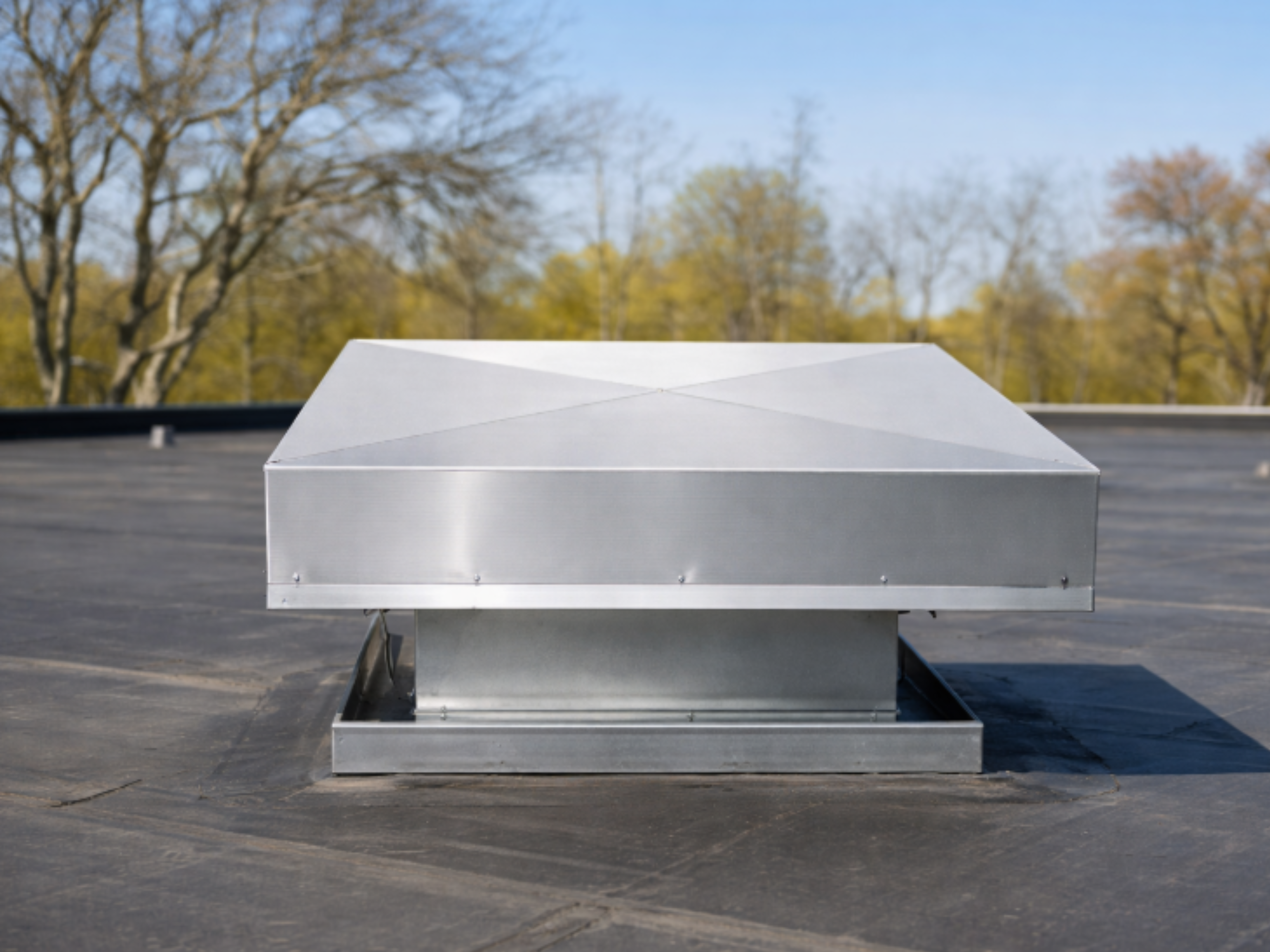
A gravity ventilator is a roof-mounted exhaust or intake device designed to release warm air using pressure differences rather than mechanical power. In commercial and industrial buildings, it serves as the upper outlet in a passive airflow path that begins at lower intake openings and ends at the highest practical point in the structure.
When engineers ask what is a gravity ventilator in practical terms, the answer lies in airflow behavior rather than form. Rather than relying on motors or controls, the ventilator functions as a protected opening that allows air to leave a building while limiting rain intrusion, debris entry, and wind-driven backflow. Performance depends less on moving parts and more on how temperature, pressure, and elevation differences act across the building enclosure.
How Do Gravity Ventilators Work at a System Level
At a system level, gravity ventilators function by linking vertical separation, temperature-driven pressure differences, and controlled openings into a continuous airflow path.
Thermal Buoyancy and Pressure Differentials
Thermal buoyancy is a primary driver of gravity ventilation under stack-driven conditions. As indoor air warms, it becomes less dense and migrates upward toward the roof. That vertical movement establishes a pressure difference between the interior and the outdoor environment at lower elevations.
At the roof, gravity ventilators provide a controlled exit point for this rising air. As warm air leaves the building, interior pressure drops slightly. Cooler outdoor air then enters through lower openings to replace it. This pressure-driven exchange explains how do gravity ventilators work without motors or controls.
The Role of Wind in Natural Ventilation
Wind also shapes gravity ventilation by altering pressure conditions around the building. Airflow moving across a roof surface can generate localized low-pressure zones above roof openings, increasing exhaust potential under certain conditions.
In practice, wind and buoyancy work together. Their relative influence shifts with wind speed, direction, temperature differentials, and building geometry. Depending on conditions, wind may assist exhaust or disrupt pressure balance, which is why reliable systems account for this variability through placement and component selection.
Key Components in a Gravity Ventilation Assembly
Gravity ventilation assemblies rely on coordinated exhaust, intake, and control elements to maintain stable airflow across changing operating conditions.
Roof-Mounted Gravity Ventilators
Roof ventilators act as the exhaust termination for rising warm air. Geometry and weather protection determine how effectively air can exit while resisting rain intrusion and wind reversal.
Location plays a direct role in performance. Ventilators must be positioned where buoyancy forces can develop fully rather than being short-circuited by nearby openings or roof features. Poor placement reduces effective draw regardless of ventilator design.
Wall Louvers and Intake Openings
Exhaust alone cannot create airflow. Intake openings are required to replace displaced air and sustain movement through the space. Wall louvers commonly fill this role by admitting outdoor air while controlling water, debris, and pest intrusion.
Airflow behavior depends on balance. The relationship between intake free area and exhaust capacity governs velocity, distribution, and whether air sweeps across the occupied zone or bypasses it entirely.
Dampers and Airflow Stability
Control components influence how gravity systems respond to changing conditions. Devices such as barometric relief dampers and backdraft dampers shape pressure response and airflow direction during wind shifts or low-temperature differentials.
Understanding the differences between barometric dampers vs backdraft dampers helps understand how passive systems maintain predictable airflow paths rather than allowing reverse flow or uncontrolled leakage.
Performance Characteristics of Gravity Ventilation Systems
Evaluating gravity ventilation requires comparing operating conditions against the limits of passive airflow rather than assuming uniform performance.
Where Gravity Ventilators Perform Well
Gravity ventilation performs best when indoor temperatures exceed outdoor conditions and when vertical separation between intake and exhaust points is sufficient to create meaningful pressure differences. Facilities with high ceilings and internal heat generation often see the strongest results from this approach.
Under these conditions, gravity ventilators deliver steady exhaust and low maintenance demands. Airflow can remain consistent without mechanical assistance. These conditions also illustrate how do gravity ventilators work most effectively in facilities where heat loads and vertical separation support sustained buoyancy-driven airflow.
Where Gravity Ventilation Reaches Its Limits
As indoor and outdoor temperatures approach equilibrium, performance declines. Reduced temperature differentials weaken buoyancy forces, lowering total airflow rates even in well-designed systems.
These limits are predictable. Gravity ventilators continue to release accumulated heat near the roof, but they do not provide precise temperature control or cooling below ambient conditions. Recognizing this behavior is essential when evaluating how do gravity ventilators work relative to mechanical alternatives.
Hybrid and Assisted Gravity Ventilation Approaches
When passive airflow alone proves insufficient, assisted strategies are often introduced. Hybrid systems add low-energy fans at intake locations while preserving gravity-driven exhaust.
The result is improved consistency during low-buoyancy periods without abandoning the advantages of passive exhaust. Understanding where pure gravity ends and assistance begins helps engineers select appropriate system architectures.
Design and Operational Considerations
Early decisions determine whether gravity ventilation behaves as a predictable system or an inconsistent one over time.
Design Factors That Influence Performance
Selecting gravity ventilators requires evaluating roof area, structural spacing, expected heat loads, intake locations, and prevailing wind patterns early in design. Poor placement can cause airflow to bypass occupied zones or short-circuit between openings.
Sizing decisions matter just as much. Intake and exhaust must be balanced to avoid excessive pressure loss or stagnant zones. Together, these choices determine whether gravity ventilation performs as intended or underdelivers.
Durability and Energy Considerations
Gravity ventilators contain few moving parts and no motors, which contributes to long service life and low maintenance requirements. Because operation does not depend on electrical availability, reliability improves in facilities where uptime is critical.
With no operational energy demand, gravity ventilators reduce long-term energy costs compared to continuously powered exhaust systems. This efficiency remains one of their strongest advantages in suitable applications.
Matching Gravity Ventilators to Building Conditions
Clarifying how do gravity ventilators work helps align expectations with physical reality. Gravity systems remove accumulated heat and promote air exchange through predictable pressure behavior rather than delivering precise environmental control.
Evaluating ceiling height, internal heat generation, and intake placement together shows how gravity ventilation performs under real operating conditions rather than theoretical assumptions. Height, heat load, climate, and airflow paths ultimately determine outcomes.
Specify Gravity Ventilation Solutions with United Enertech
United Enertech provides gravity ventilation components designed for commercial and industrial airflow applications. Our team helps engineers and facility managers evaluate building conditions, airflow paths, and control strategies to determine whether gravity ventilation is appropriate. We support system selection that aligns with performance requirements and long-term operational goals. Contact us today for more information.