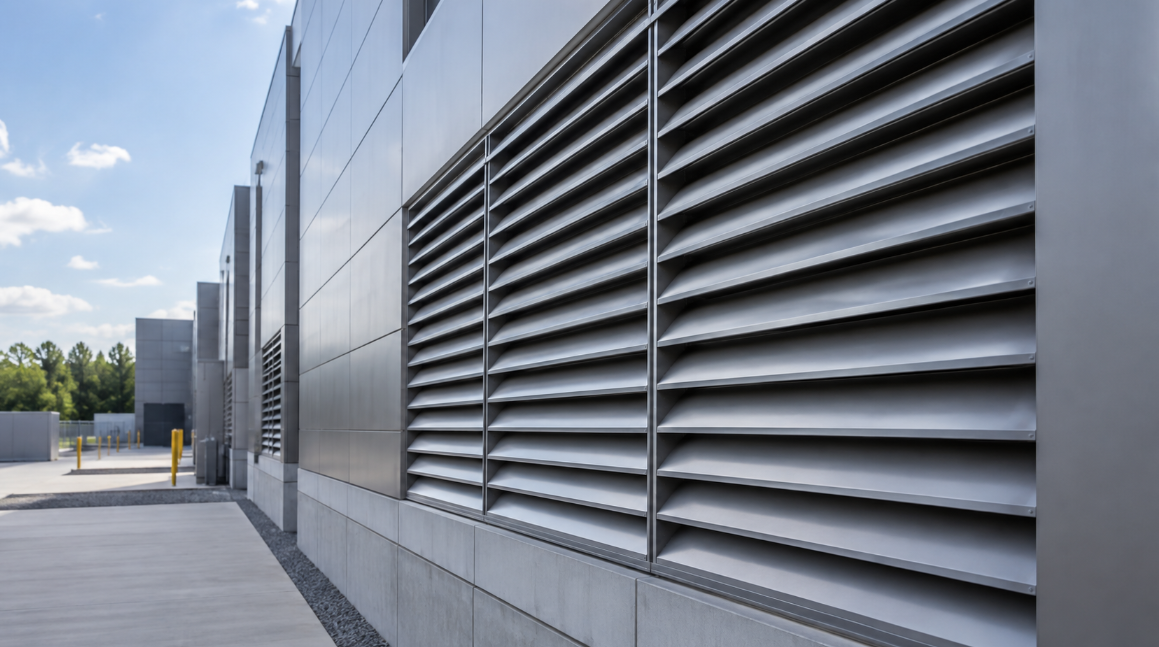
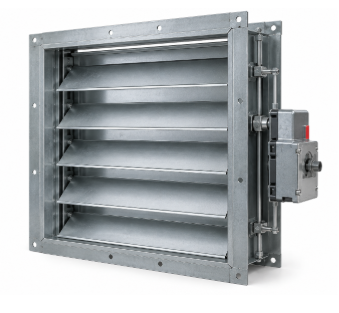
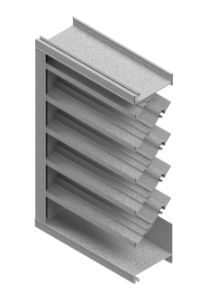
Most discussions of airflow in data centers begin at the rack, leaving the exterior intake and relief path outside the frame. Poorly specified intake and relief components can create downstream thermal problems, excessive resistance, and water-intrusion risk before air reaches the white space. For data centers that use outdoor air for cooling or ventilation, data center airflow begins at the building envelope and depends on louvers and dampers that admit, protect, control, and relieve air.
Where Does Data Center Airflow Begin at the Building Envelope?
Airside economization uses suitable outdoor air to reduce the amount of mechanical cooling required. When the operating strategy calls for large outdoor-air volumes, the exterior opening becomes part of the cooling system rather than a minor architectural detail.
That changes the sizing equation for data center airflow. Airflow volume, louver dimensions, velocity, pressure drop, water performance, and the downstream control sequence all have to work together if the intake is going to support the intended operating condition.
How Do You Size a Data Center Air Intake Louver?
Sizing a data center air intake starts with the required airflow, but the overall face dimensions of the louver do not tell the complete story. Engineers also need to evaluate how much of that opening is actually available for airflow and what resistance the selected louver creates at design conditions.
Free Area and Opening Size
Free area is the minimum area through a louver through which air can pass. Dividing the required airflow by the available free area establishes the free-area velocity through the louver.
Less free area means the same airflow must pass through a smaller effective opening. The louver may therefore need a larger face area to keep velocity within the range required for pressure-drop and water-performance goals, and published free area should be checked for the actual louver size because frame and blade geometry affect the percentage. That makes louver sizing an architectural coordination issue as well as a mechanical one.
For airside economizer louvers, this relationship becomes especially important because larger outdoor-air volumes can push physical opening dimensions well beyond what a simple nominal louver size suggests. The selected opening has to support the required data center cooling airflow without creating an unnecessary velocity penalty.
Pressure Drop at Design Velocity
Pressure drop should be evaluated at the project's design airflow and velocity instead of treated as an isolated catalog number. As resistance through the intake rises, the fan system must overcome additional pressure loss to move the required data center airflow.
The energy consequence depends on how much air moves through the path and how many hours that condition occurs. Long operating periods can magnify the effect of added resistance on fan energy, available system pressure, and equipment selection, and the design velocity also matters when the engineer evaluates the louver's water performance.
Why Does Water Penetration Require Special Attention at the Intake?
Water entering a mission-critical intake can create outage-level risk because moisture may reach filters, ductwork, air-handling equipment, electrical systems, or downstream spaces. The beginning point of water penetration is the free-area velocity at which the AMCA test-data curve reaches the defined threshold of 0.01 oz of water per square foot of free area. AMCA 500-L is a laboratory standard that establishes methods for testing louver performance under defined conditions.
The threshold gives engineers a consistent performance point when comparing louver models, but the test conditions still need to correspond to the project requirement. AMCA 500-L testing is not the same thing as product certification, and conventional water-penetration data does not represent every storm condition. Wind-driven rain louvers use a different performance approach for exposed openings where moving air and rainfall create a more demanding condition, and the surrounding intake design still requires suitable drainage or other water-management provisions.
Which Louver Fits the Site Exposure?
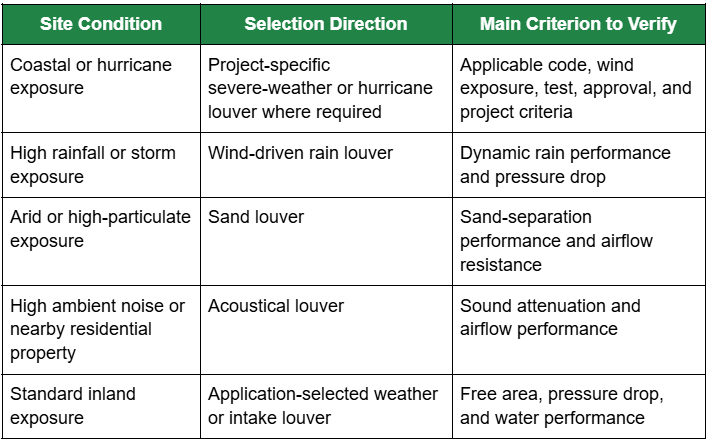
The same louver specification will not fit every data center site. Power availability and the time required to bring new capacity online now weigh heavily in data-center site selection, and expansion into secondary and emerging markets makes project-specific intake criteria increasingly important. Data center louvers should therefore be selected against the actual environmental exposure at the opening.
Wind-driven rain louvers fit applications where dynamic rain exposure is a primary concern, and sand louvers address arid or high-particulate environments where windborne sand must be managed. Hurricane or severe-weather louvers may be appropriate where the applicable code, wind exposure, approval, or project criteria require that level of performance, while acoustical louvers address openings where sound transmission is also part of the design problem. United Enertech louvered penthouses can provide weather-protected roof-level intake or exhaust paths when the equipment arrangement and building design favor roof openings.
How Do Dampers Control the Economizer and Relief Air Paths?
Once a louver admits and protects the outdoor-air path, data center dampers determine how much air moves through that path, where it goes, and when a section needs to close or isolate.
Control Dampers and Economizer Modulation
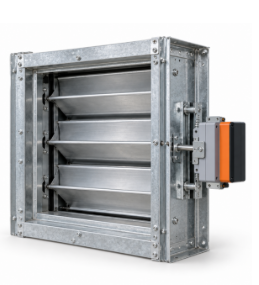
During airside economizer operation, control dampers regulate the outdoor- and return-air paths according to the sequence of operation. As outdoor conditions change, actuators and controls must reposition the dampers predictably between operating states.
Air-leakage class identifies the maximum allowable leakage through a closed damper at specified pressure conditions. AMCA rating procedures provide the basis for that classification. Low-leakage performance matters during extended periods when an outdoor-air path is commanded closed because unwanted leakage can introduce heat, humidity, contaminants, or pressure imbalance, and United Enertech offers control dampers with published airflow and leakage-performance data for applications that include data centers.
United Enertech's discussion of airside economization and data center energy efficiency places these components within the larger cooling and energy strategy. For data center ventilation systems using outside air, the louver establishes the exterior opening and the control damper regulates how that opening participates in the operating sequence.
Relief and Backdraft Dampers
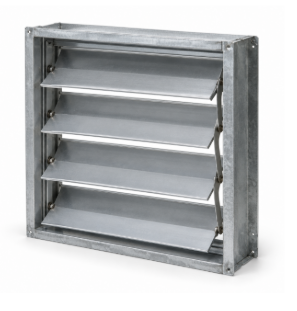
Relief dampers provide an exit path when the system must discharge air to maintain the intended pressure relationship. United Enertech backdraft dampers allow airflow in the intended direction and resist reverse flow when pressure conditions change or equipment shuts down.
Both components add resistance to the air path, so opening pressure and pressure drop remain part of the selection criteria. A damper can perform its intended directional or relief function and still create a system problem if the required airflow cannot pass through it at an acceptable resistance.
Isolation Dampers and Redundant Air Paths
Redundant designs introduce another requirement: an inactive path must be capable of being separated from the operating system. If one air-handling path is taken offline, the selected damper must keep that inactive section from remaining open to the rest of the system.
The shutoff performance has to match the pressure and control conditions created by the redundancy strategy. Proper isolation allows maintenance or equipment changes to occur without unintentionally altering the active air-handling path serving the operating space.
Combination Louver-Damper Assemblies
A combination louver-damper assembly integrates exterior weather protection with airflow regulation or shutoff at the same opening. One assembly can simplify coordination where the exterior wall needs both functions.
Separate components may still make sense when the project requires different component locations, independent service access, or different control conditions. An integrated assembly is appropriate when it can satisfy the required weather performance, pressure drop, leakage, control, and access criteria without compromising one function to accommodate another.
Where Do Code and Life-Safety Dampers Enter the Air Path?
Fire and smoke dampers enter the design where ductwork or air openings penetrate rated assemblies and the governing code requires the applicable life-safety protection. The requirement depends on the barrier type, system arrangement, applicable listing, and adopted code rather than on the building being a data center by itself.
Energy-code requirements require similar project-specific review. ASHRAE 90.4-2025 is the current ASHRAE energy standard written specifically for data centers, while ASHRAE 90.1 addresses broader commercial-building requirements. An economizer requirement does not automatically create an outdoor-air intake requirement because different economizer strategies are available, but where the applicable strategy is airside economization, the exterior-air-path components must be coordinated with the sequence of operation.
How Do Acoustical Louvers Attenuate Sound Through Large Openings?
Large ventilation openings create a path for mechanical sound through the building envelope. Generator yards, cooling equipment, and high-airflow openings can contribute to community or property-line noise concerns when a facility sits near noise-sensitive receptors.
United Enertech acoustical louvers add sound attenuation through a required ventilation opening. Acoustic performance does not eliminate the airflow requirement, so free area and pressure drop still have to be evaluated alongside the sound criterion.
Which Components Belong in the Envelope Air Path?
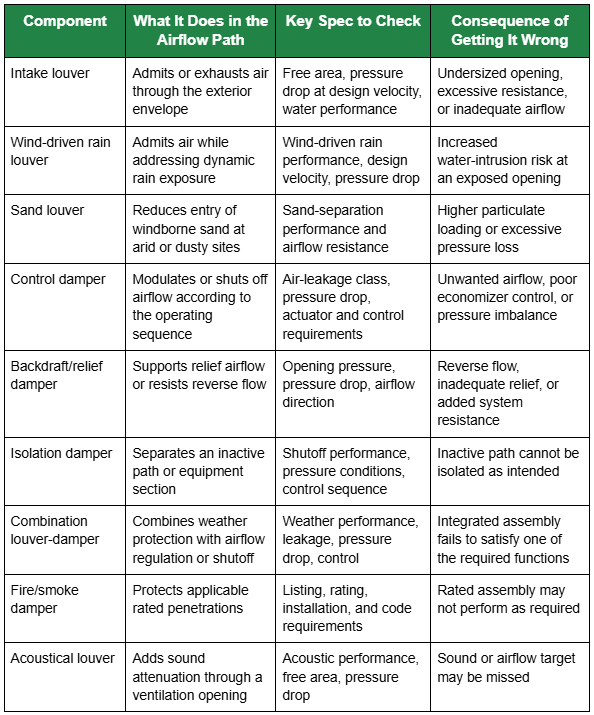
Each component in the envelope air path has a specific job. The relevant specification changes with that function, and the consequence of incorrect selection can range from excess resistance to water intrusion, loss of control, or failure to isolate a path as intended. Reviewing those relationships together helps keep the intake, control, relief, and protection functions of data center airflow coordinated.
Specify the Envelope Air Path With United Enertech
United Enertech offers louver and damper options for projects requiring coordinated weather protection, airflow control, relief, acoustics, and life-safety performance at the building envelope. The project team can evaluate airflow requirements, environmental exposure, and component performance criteria to help identify the characteristics that belong in a project-specific specification. Contact us today for more information.
Frequently Asked Questions
These answers address common specification questions about louvers and dampers in the data center envelope air path.
What Louvers Are Used in Data Centers?
Louvers for data centers can include conventional intake louvers, wind-driven rain louvers, sand louvers, hurricane or severe-weather louvers, and acoustical louvers. Selection depends on required airflow and the environmental criteria at the exterior opening.
How Do Dampers Control Data Center Airflow?
Dampers regulate, shut off, relieve, prevent reverse flow, or isolate individual air paths. The required function depends on the system's operating sequence, airflow direction, pressure conditions, and redundancy strategy.
What Is Free Area and Why Does It Matter for Data Center Intakes?
Free area is the minimum area through the louver through which air can pass. It affects velocity through the opening and therefore influences louver dimensions, pressure drop, and water performance.
Do Data Centers Need Wind-Driven Rain Louvers?
Wind-driven rain louvers are appropriate when intake exposure and project criteria require verified performance under dynamic rain conditions. A protected inland opening can have different requirements from an exposed storm-prone intake.
How Does an Airside Economizer Use Louvers and Dampers?
An airside economizer admits suitable outdoor air through the intake louver and uses dampers to regulate outdoor-, return-, and relief-air paths. Damper positions change as outdoor conditions and cooling requirements change.
Are Fire Dampers Required in Data Center Ductwork?
Fire dampers are required where the governing code and rated assembly call for them at a duct or air-transfer penetration. Applicability depends on the barrier, system configuration, adopted code, and relevant listing.