


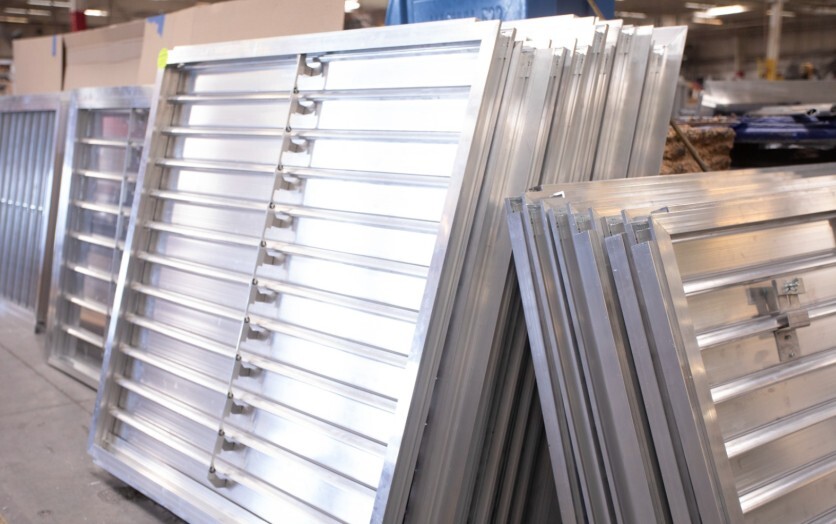
Custom Damper Design & Fabrication
Mechanical systems rarely fail because a single component was missing. They fail because a component behaved differently than expected once pressure, temperature, and operating conditions converged in the field. Dampers sit directly in that risk zone, where air control dampers regulate airflow, isolation, and system response based on how accurately a moving assembly performs under load. That reality elevates custom dampers from a procurement decision to an engineering responsibility.
Why Standard Dampers Break Down Under Real Operating Conditions
Standard dampers are designed around generalized assumptions. They assume typical duct dimensions, moderate pressure ranges, and predictable temperatures paired with straightforward actuation. In many systems, those assumptions hold long enough to satisfy code and basic function.
Problems surface when real operating conditions exceed those bounds. That pattern typically emerges after commissioning, once systems begin operating under sustained load. High differential pressure, elevated temperatures, corrosive exhaust, space constraints, or nonstandard duct geometry expose the limits of catalog configurations quickly.
Engineering Inputs That Drive Custom Damper Design
Custom design begins when airflow control must be engineered rather than selected. Instead of starting with a damper type, the process starts with system behavior. These conditions define when standard selections fall short and when custom dampers are required to maintain predictable airflow control under load.
Pressure, Temperature, And Leakage Requirements
Air volume, velocity, and pressure establish the forces the damper must resist while cycling repeatedly over its service life. Temperature affects material suitability, thermal expansion behavior, and long-term sealing durability. Leakage tolerance informs blade geometry, edge detailing, and overall seal selection.
Leakage is not evaluated subjectively in these systems. It is judged against defined performance targets tied to energy use, smoke migration risk, or process containment requirements. Custom damper design allows sealing strategies to be aligned with those targets rather than relying on nominal shutoff assumptions.
Actuation And Control Strategy Alignment
Actuation requirements dictate shaft sizing, linkage configuration, and bearing design. Stroke length, torque capacity, and fail-safe positioning must match both the damper’s mechanical behavior and the control strategy driving it. Oversized actuators can introduce unnecessary stress when torque capacity is not properly matched to damper behavior, which can shorten component life under repeated cycling.
Together, these inputs define initial performance intent before fabrication enters the picture.
Design Decisions That Shape Fabricated Performance
Design intent only matters if it survives execution. Blade geometry, sealing strategy, and structural detailing determine how a damper behaves once installed.
Damper Architecture As A Design Variable
Customization is not limited to size or material. The underlying damper architecture itself becomes a design variable when performance requirements escalate. Blade-style dampers, slide or guillotine configurations, and diverter-style assemblies respond differently to pressure, debris loading, and thermal expansion. In these scenarios, architecture selection becomes a defining factor in how custom dampers manage pressure, debris loading, and thermal movement over time.
Blade Geometry And Structural Reinforcement
Blade depth, profile, and reinforcement are structural choices, not aesthetic ones. They determine how the blade deflects under pressure and how evenly sealing forces distribute along the edge. Shallow blades may suit low-pressure systems yet flex enough under load to increase leakage or bind. Deeper or reinforced blades add stiffness while increasing weight and actuation demand.
Sealing Strategy And Environmental Exposure
Tight leakage control depends on seals that maintain contact under pressure without creating excessive friction. Temperature swings, airborne contaminants, and cycling frequency influence seal material selection and attachment. Some applications favor rigid metal-to-metal interfaces for durability, while others rely on elastomeric seals to meet defined leakage limits.
Structural And Mechanical Reliability Over Service Life
Structural components often receive less attention than blades and seals, yet they govern long-term reliability.
Frames must remain square under load to prevent binding and uneven wear. Shaft supports and bearings must carry axial and radial forces without introducing drag. In high-pressure or large-format applications, frame reinforcement is often required to maintain alignment rather than treated as an optional upgrade. Custom fabrication scales these elements with system demands instead of locking them to catalog limits.
Installation Constraints And Fabrication Accountability
Space constraints often trigger customization, yet space alone rarely defines the challenge. Nonstandard transitions, obstructions, and access limitations affect installation orientation and maintenance reach. A damper that fits but cannot be serviced introduces long-term risk.
Fabrication quality is the final expression of upstream engineering decisions, and custom damper fabrication determines how precisely those decisions translate into installed performance. Tolerances influence how smoothly blades rotate and how consistently seals engage. Welding methods affect distortion and frame alignment. Material thickness and joint detailing determine how the assembly responds to repeated loading cycles.
Operational Risk And Long-Term Performance Stability
As systems grow more complex, the cost of mismatch rises. A damper that leaks more than expected can force fans to work harder to maintain airflow targets within the system. One that binds under pressure disrupts control-loop stability. One that degrades early requires invasive replacement.
These failures rarely stem from poor intent. They stem from designs that underestimated operating conditions. Custom dampers close that gap by aligning design, fabrication, and system behavior.
Why Custom Dampers Matter Once Systems Are Operating
Once systems move from design intent to live operation, performance expectations shift from theoretical capability to sustained, real-world behavior under changing loads and conditions.
Escalating Operating Demands Exceed Standard Assumptions
The decision to pursue customization is often framed as a response to unusual conditions, yet many modern systems sustain operating demands that exceed the assumptions behind standard product selection. Higher energy targets push systems toward tighter control and lower leakage throughout daily operation. Smoke control strategies impose pressure differentials during emergency events that conventional assemblies may not tolerate repeatedly.
Application Environments Where Performance Becomes Critical
In practice, this escalation appears in applications such as exhaust systems, process air handling, smoke management paths, and industrial ventilation where temperature, contamination, or duty cycle cannot be treated as intermittent. In these environments, damper performance becomes a reliability issue rather than a sizing exercise.
System Integration And Control Stability Over Time
Once systems are active, integration determines whether that risk remains controlled. Dampers interact continuously with fans, sensors, and control algorithms responding to changing loads and schedules. A damper that moves inconsistently or leaks unpredictably injects instability into the control loop, reducing efficiency and responsiveness. Over time, that instability compounds.
Lifecycle Durability And Maintenance Predictability
Material selection becomes increasingly consequential as exposure accumulates. Galvanized steel may perform adequately in controlled HVAC environments yet degrade faster in high-temperature exhaust or corrosive atmospheres. Stainless alloys, specialty coatings, or increased material thickness may be required to maintain alignment and sealing performance.
Dampers designed around defined duty cycles exhibit predictable wear patterns, simplifying inspection and service planning. Assemblies that remain aligned and properly sealed reduce unplanned downtime and performance drift, lowering total cost of ownership over the system’s service life.
Customization Versus Modification In Damper Applications
Modifying a standard damper to fit a space or connection does not address long-term performance demands. True customization begins by defining how the damper must behave under sustained operating conditions and proceeds through design and fabrication to achieve that outcome.
At that point, the discussion moves away from what is readily available and toward who is accountable for long-term performance. Custom dampers reduce uncertainty when performance is anchored to defined, sustained operating criteria rather than nominal ratings.
Design Engineered Dampers With United Enertech For Reliable System Performance
United Enertech engineers and fabricates dampers designed around real operating conditions, not catalog assumptions. Each assembly is developed to align pressure, temperature, leakage, and actuation requirements with fabrication methods that support long-term reliability. Contact us today for more information.